Daraxonrasib in Pancreatic Cancer: What GPs Should Know
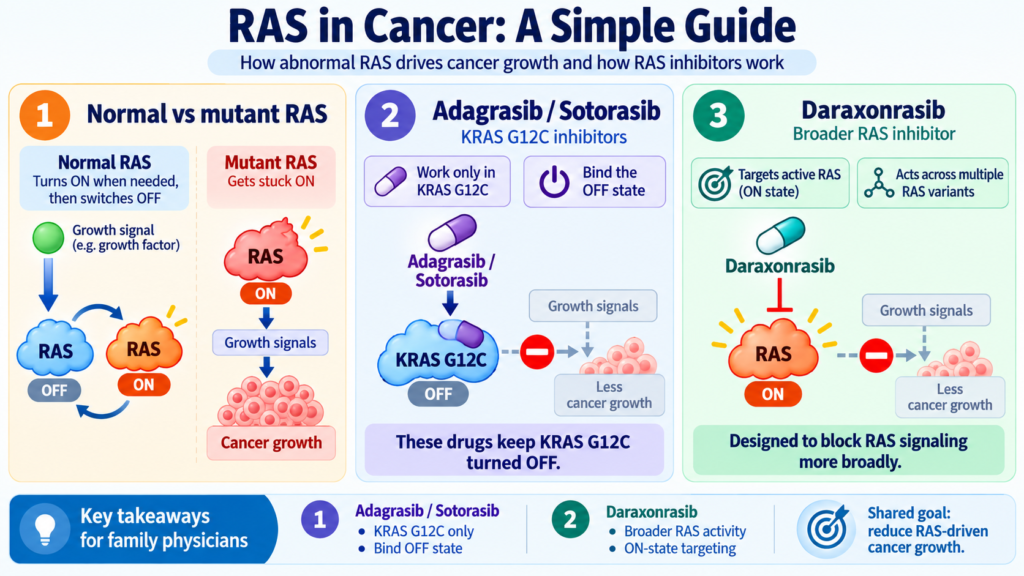
The US FDA has approved daraxonrasib in pancreatic cancer. The drug, an oral RAS inhibitor, is indicated for adults with metastatic pancreatic adenocarcinoma who have received at least one previous systemic therapy or are not candidates for multiagent systemic therapy.
This is an important development in pancreatic cancer. Targeted treatments have previously been available mainly for small molecular subgroups. Daraxonrasib targets the RAS pathway, which drives the great majority of pancreatic ductal adenocarcinomas.
For family physicians, the key message is simple:
A targeted treatment is now available against the pathway responsible for most pancreatic cancers—not merely a rare molecular subtype.
Why this approval is different
KRAS mutations occur in several common cancers and are found in more than 90% of pancreatic ductal adenocarcinomas. Mutated KRAS keeps growth-promoting signals switched on, allowing cancer cells to continue proliferating.
However, developing drugs that directly inhibit KRAS has been exceptionally difficult.
In 2021, sotorasib became the first direct KRAS inhibitor to receive US FDA approval. Its activity, however, is restricted to one specific variant—KRAS G12C. This differs from familiar targeted therapies such as imatinib, which is used on the basis of the presence of the BCR::ABL1 fusion in chronic myeloid leukaemia, or osimertinib, which targets the two most common sensitising EGFR alterations in non-small-cell lung cancer: exon 19 deletions and exon 21 L858R.
The first generation of KRAS inhibitors therefore benefited only patients with one particular KRAS variant. This was especially limiting in pancreatic cancer, where KRAS G12C is uncommon and G12D, G12V and G12R are considerably more frequent.
Daraxonrasib takes a broader approach. Unlike the first KRAS inhibitors, which targeted only KRAS G12C, daraxonrasib can inhibit several RAS variants. This makes RAS-directed treatment relevant to a much larger proportion of patients with pancreatic cancer.
What did RASolute 302 show about daraxonrasib in pancreatic cancer?
The phase III RASolute 302 trial enrolled approximately 500 patients with metastatic pancreatic adenocarcinoma who had received one previous systemic treatment. Participants were randomly assigned to daraxonrasib or the investigator’s choice of chemotherapy.
| Outcome | Daraxonrasib | Chemotherapy |
|---|---|---|
| Median overall survival | 13.2 months | 6.7 months |
| Median progression-free survival | 7.2 months | 3.6 months |
| Objective response rate | Approximately 30% | Approximately 11% |
The hazard ratio for death was 0.40, corresponding to a 60% relative reduction in the risk of death during the study period. Patient-reported outcomes also favoured daraxonrasib, including delayed worsening of pain and quality of life.
For previously treated metastatic pancreatic cancer, these are clinically substantial results.
Is molecular testing required?
Surprisingly, no.
Although the biological rationale is based on the high prevalence of RAS mutations, the trial permitted enrolment regardless of RAS mutation status. Benefit was demonstrated among patients with RAS G12 mutations and in the overall study population.
The US FDA indication therefore does not require:
- a particular KRAS variant
- a documented RAS mutation
- an US FDA-approved companion diagnostic
This should not be interpreted as an argument against molecular testing. Germline and tumour genomic testing remain important because they can identify other actionable alterations, clarify hereditary risk and open clinical-trial options.
Where does daraxonrasib fit?
Daraxonrasib does not replace established first-line combination chemotherapy in fit patients.
Its principal current role is after progression on at least one systemic treatment for metastatic disease. The US FDA indication also includes patients considered unsuitable for multiagent systemic therapy.
Whether daraxonrasib will move into earlier treatment settings or be combined with chemotherapy or other RAS-directed drugs remains under investigation.
Toxicities the family physician should recognise
Oral targeted therapy should not be equated with mild or toxicity-free treatment.
Important adverse effects and warnings include:
- rash and other dermatological toxicity
- stomatitis and oral inflammation
- diarrhoea
- soft-tissue toxicity
- gastrointestinal perforation
- interstitial lung disease or pneumonitis
A patient receiving daraxonrasib should be referred promptly to the oncology team for:
- new or worsening breathlessness, cough or hypoxia
- persistent or severe diarrhoea
- painful or extensive oral ulceration
- significant rash, blistering or soft-tissue inflammation
- acute or severe abdominal pain
Medication reconciliation is also important. The oncology team should be informed before prescription medicines, over-the-counter drugs or supplements are started or discontinued because clinically relevant drug interactions may occur.
Why this matters to the family physician
Daraxonrasib marks a change in the pancreatic cancer treatment narrative.
Until recently, finding a KRAS mutation in pancreatic cancer usually explained the tumour’s behaviour without providing a corresponding treatment. Daraxonrasib converts the most prevalent molecular driver in pancreatic cancer into a therapeutically accessible pathway.
The family physician is unlikely to initiate this treatment but may:
- encounter patients receiving it
- recognise treatment-related toxicity
- help reconcile concurrent medicines
- reinforce adherence to an oral anticancer drug
- understand why genomic testing and specialist reassessment remain relevant after progression
Key Points
- KRAS mutations occur in more than 90% of pancreatic ductal adenocarcinomas.
- Daraxonrasib is an oral targeted therapy that inhibits several RAS variants rather than one specific KRAS mutation.
- In RASolute 302, median overall survival was 13.2 months with daraxonrasib and 6.7 months with chemotherapy.
- Its present role is principally in previously treated metastatic pancreatic adenocarcinoma.
- Targeted therapy does not mean toxicity-free therapy. Rash, diarrhoea, oral toxicity, pneumonitis and gastrointestinal complications require recognition.
Regulatory note
Daraxonrasib received US FDA approval on 26 August 2026. Approval, availability, indications and prescribing requirements may differ between countries.
References
- FDA approval of daraxonrasib for metastatic pancreatic adenocarcinoma.
- O’Reilly EM, Wainberg ZA, Hendifar AE, et al. Daraxonrasib or Chemotherapy in Previously Treated Metastatic Pancreatic Cancer. N Engl J Med. 2026;395:325–337.
- Daraxonrasib US prescribing information.
This article is intended for medical education and does not replace individual clinical assessment, current prescribing information or specialist oncology advice.